Should Denver pick up Bo Nix's fifth-year option? Yes. The extension is the hard part.
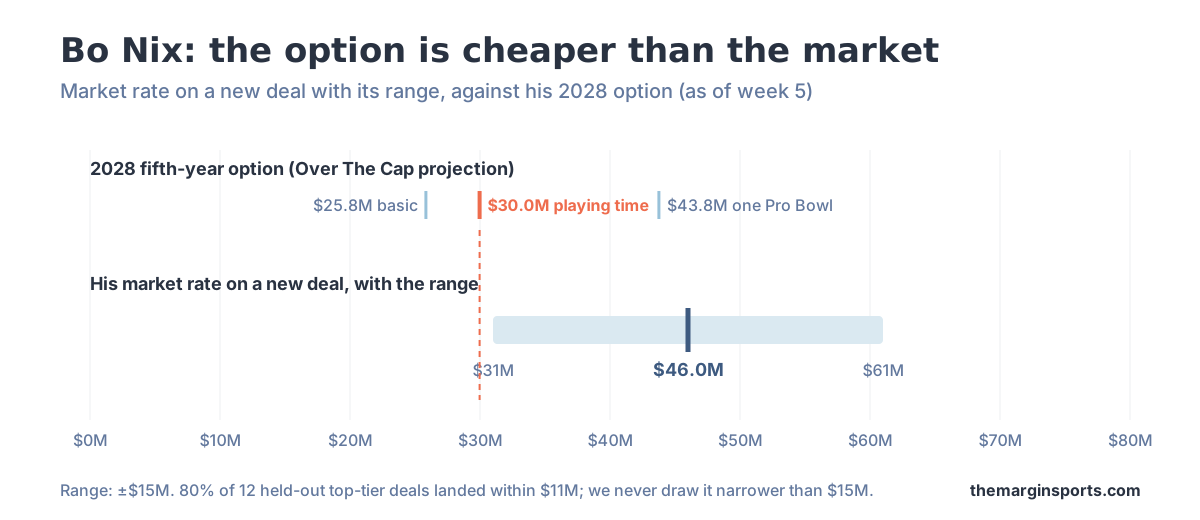
Denver has until May to decide on Bo Nix's fifth-year option, projected at $30.0M for 2028. We priced every starting quarterback on what his recent play would earn on a new deal. Nix comes out at $46.0M a year, and even the low end of our range clears the option, by $1.0M. The extension is a different question.
Every first-round pick's rookie deal comes with a team option on a fifth year, and Denver has to decide on Bo Nix's by May 3, 2027. Over The Cap projects his 2028 option at $30.0M, the playing-time level, which he's on track to reach. So the question is simple: would Nix cost more than $30.0M a year on the open market?
I built a model to answer that for every starting quarterback, and for Nix the answer is yes. His market rate is $46.0M a year, about $16M above the option. Our range runs from $31M to $61M, so even the low end clears the option, though only by $1.0M.
 Tap to open full size, or swipe to pan.
How we priced him
The idea is to look at what teams have actually paid quarterbacks, and how those quarterbacks had played right before they signed. Then ask what Nix's recent play would get him.
- The deals: 551 free-agent signings and extensions since 2016, one per signing. Rookie deals, practice-squad call-ups and the short deal a quarterback signs right after he's cut partway through a big contract are left out. That last one is priced around money his old team still owes him.
- The inputs: our QB grade over the 18 league weeks before he signed and the 18 before that, his form with recent games counted most, how much he played, games he missed hurt, his age, and whether it was his second contract.
- The scale: each deal is measured against the top of the QB market when it was signed, the average of the five biggest QB contracts from the 3 years before. For a deal signed this offseason that's $57.8M a year. We measure it in dollars, not as a share of the cap, because the dollar version priced the most recent big deals far better.
- The models: a gradient-boosted model and a linear one, averaged.
Nix's inputs are a form of 46.8, which ranks 16th of the 28 quarterbacks we could price (50 is average). He played 17 of 17 games over the last 18 league weeks and 717 plays, and he turns 27 in 2027. That's a durable starter in the middle of the league.
How wrong it can be
I trust the number as far as it held up on deals it never saw. We fit the model on deals from 2016 to 2022, then had it price the deals signed from 2023 on.
- On 24 starter deals (5% of the cap or more), the average miss was $7.5M a year. A simple baseline, the average starter's share of the market, missed by $13.0M. On the four top deals signed in 2025 and 2026, it ran $0.7M high on average.
- For quarterbacks the model priced above $45M, 80% of the misses were within $11M, with no real lean (−$3.3M on average across 12 deals). Twelve deals is not many, so the range we draw is wider: ±$15M. $46.0M minus $15M is $31.0M.
- The two models don't agree exactly. For Nix it's $48.1M from one and $44.0M from the other. Across the 28 priced quarterbacks the median gap is $8.3M.
So I wouldn't defend the decimal in $46.0M. The call doesn't need it. It needs the low end of the range to clear $30.0M, and it does, barely.
What would change the answer
The cushion at the low end is thin: $1.0M. If his market rate fell by that much, the bottom of the range would sit under the option and I'd call it a lean instead of a yes. For the rate itself to fall below the option, it would have to drop about $16M. That takes playing like a backup for most of a season, or losing the job. A week of games moves these numbers by a few million dollars.
The other thing to watch is the option tier. If Nix makes a Pro Bowl before the deadline, the projected option jumps to $43.8M. That's just $2.2M under his market rate, well inside the range, so it would become a close call.
The extension is the harder question
Picking up the option is easy. Paying him is harder. At $46.0M a year, Denver would be paying full market price for a quarterback whose form ranks in the middle of the league.
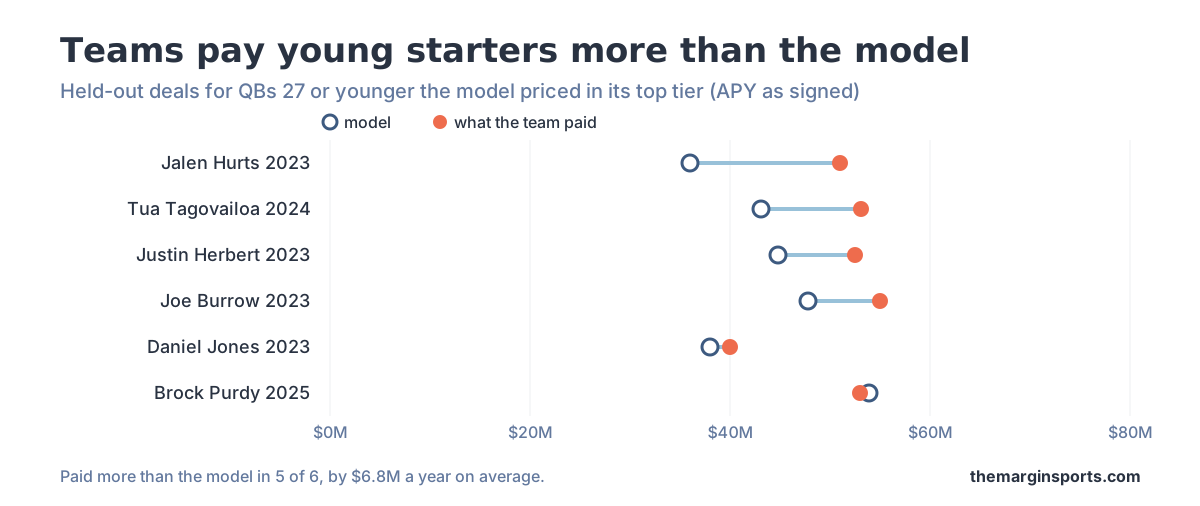
And history says a Nix extension would cost more than our number. In the test years, the model priced 6 deals for quarterbacks 27 or younger in its top tier. Teams paid more than the model in 5 of them, by $6.8M a year on average.
 Tap to open full size, or swipe to pan.
Trevor Lawrence is the closest comparison by form. When Jacksonville extended him in 2024, his form was 47.2, about where Nix is now. The model said $36.7M a year. The Jaguars paid him $55.0M, 21.5% of the cap.
Teams pay young starters for the seasons they expect to get, and the model only knows the seasons that already happened. If Denver wants to extend Nix this offseason, I'd expect a price closer to $52.8M (our number plus that $6.8M average gap) than to $46.0M, and the bet is that he plays better than a middle-of-the-league quarterback.
My take: pick up the option, because it's the cheap part. Let the rest of this season decide the extension.
Every quarterback
The QB market value page has every starter we can price, and it updates every Tuesday. Brock Purdy has the highest market rate at $63.0M. Drake Maye has the best form at 60.3, and on a rookie deal his next contract prices at $61.3M.
No veteran starter is paid clearly above or below market by more than our ±$15M range. We compare each contract's average per year as signed, the number Over The Cap quotes, with his market rate: 9 are within range and 2 get no call. Nine more signed this year, and those get no verdict, because the market set that price months ago. Patrick Mahomes signed for $64.0M a year, and the model prices his play at $46.3M. That gap says more about what the model can't see than about the Chiefs. Another 15 quarterbacks can't be priced yet: backups who aren't playing, rookies who missed time we can't explain, and quarterbacks on the short deal they signed after being released.
What this can't tell you
The model doesn't see guarantees or contract length, and those are a big part of what a team actually commits. It doesn't see the supporting cast either, and the QB grade includes the line, the receivers and the play-caller. Team need and how many starters are available in a given offseason aren't in it. The option figures are Over The Cap's projections, which I haven't checked against the final numbers. Those are set in 2027.
All numbers are as of week 5.
Data in this article
Follow The Margin
New analysis lands here first. Subscribe by RSS or follow @themarginsports on X.
Keep reading
More from The Margin
All analysis- Every quarterback since 1999, game by game
Jesse McConnell, Sep 29, 2026. NFL, 6 min read
A new tool: every QB since 1999, game by game, with an honest range around each line and a 'right now' view. Brock Purdy leads today, but his range overlaps everyone in the top nine. Late bloomers are rare: 2 of 56 QBs who were average or worse after 32 games became good ones.
- Can you predict an NFL quarterback from college? The draft looks smarter than it is.
Jesse McConnell, Sep 28, 2026. NFL, 10 min read
Draft slot predicts which QBs make it better than any college stat, mostly because high picks get the snaps. Among QBs who got a real chance, ESPN's pre-draft board predicted nothing about how well they played. A team taking a QB earlier than the board did, and college rushing, both did.
- The 'nerd kings' are a myth. The QB the stats undersell is Brock Purdy.
Jesse McConnell, Sep 25, 2026. NFL, 8 min read
Love ranks 6th of 32 in EPA per dropback and 2nd of 17 in the playoffs. Herbert ranks 19th, and the efficiency stats never rated him. Clutch doesn't repeat. What separates Mahomes, Allen and Jackson is what happens when the play breaks. And since 2022, nobody has been more efficient than Purdy.